

By Erik Kiel, president, 3DT LLC
Plastics part decorating/printing often begins with choosing the correct surface treatment and/or surface cleaning technology. Today, plasma is a popular choice for all types of plastics decorating applications. This article explores the benefits of both plasma surface treatment and cleaning.
Benefits of Plasma
Atmospheric plasma surface treatment is widely used to improve the bonding of inks, paints, adhesives and coatings on low-surface-energy materials. In a single pass of the high-energy plasma beam, three critical surface preparation steps occur simultaneously:
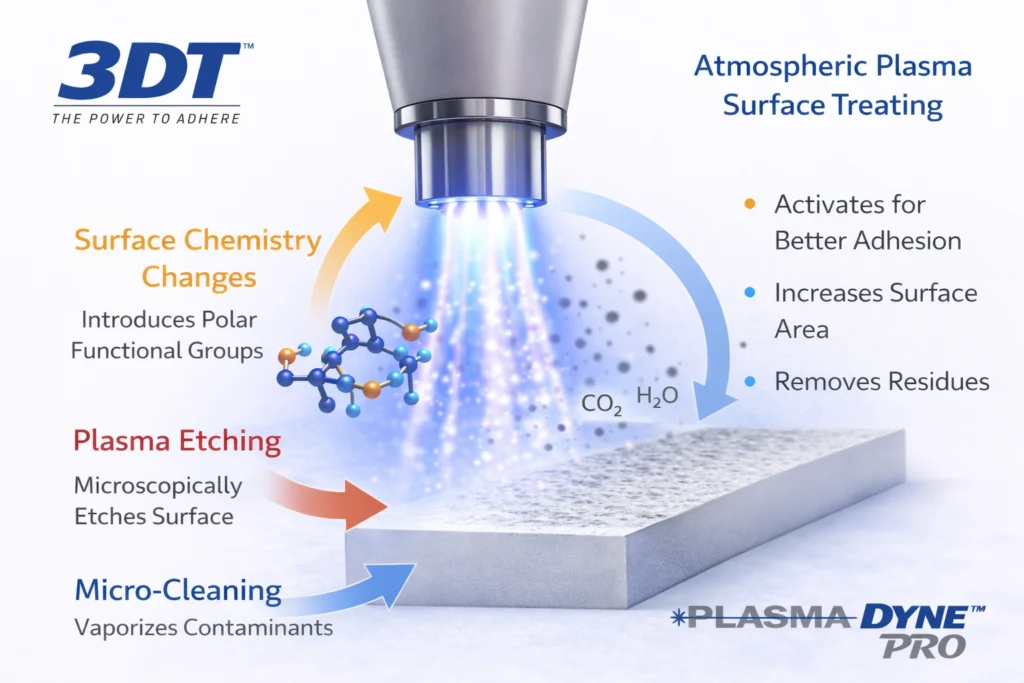
- modification of the material’s molecular structure to increase surface energy,
- removal of organic contaminants while functionalizing the surface and
- micro-etching of the surface to create a more receptive physical structure.
These combined effects (see Figure 1) improve adhesion between the substrate and inks, coatings and adhesives. Plasma treatment is compatible with a wide range of materials, including plastics, rubber, glass, composites, metals and paperboard. Plasma systems integrate well into a variety of plastics molding operations, as well as many other production lines.
By increasing surface energy and functionalizing the material, plasma treatment helps manufacturers produce more consistent, high-quality products while reducing waste. Stronger, more reliable adhesion results in crisp, durable print quality and stronger bonding between decoration, coatings, materials and components. When adhesion is consistent, scrap rates drop, and fewer parts need to be reworked or discarded.
Modern plasma systems also use advanced programming and process controls to ensure repeatable treatment results. This precise control minimizes variability and helps maintain consistent production speed and quality.
Many systems now incorporate Smart Manufacturing features such as continuous monitoring of generator parameters, Ethernet/IP connectivity for remote data collection and discrete I/O integration for system control. These capabilities allow operators to monitor performance and make real-time adjustments, helping reduce waste, improve cycle times and support data-driven production.
Case example
Manufacturers of printed circuit boards (PCBs) utilize plasma treating to clean the PCBs of dust, flux and residue prior to adding conformal coating. Likewise, electronic end connectors are plasma treated to clean them of factory debris to ensure good connections.
Key Features in Considering Plasma Treatment/Cleaning Systems
Selecting the right atmospheric plasma treatment system begins with choosing a supplier that understands the application, not just the equipment. Every material and production process is different, so it’s important to work with a company that listens, evaluates the specific requirements and collaborates on a solution that integrates smoothly into the existing production environment.
For many operations, this may require selecting a manufacturer capable of delivering a turnkey system that includes product handling and automation. A reputable supplier also should offer material testing and provide detailed lab reports to confirm treatment effectiveness before the equipment is built.
When evaluating the plasma system itself, several features are particularly important. Intuitive programming and ease of use help operators quickly establish and maintain optimal treatment parameters. A modular system design also can be valuable, allowing production to continue running smoothly if maintenance or a component replacement is needed.
Many manufacturers prefer systems designed with Smart Manufacturing capabilities, including digital data collection, system diagnostics and real-time process monitoring. These features help operators maintain consistent treatment results, reduce variability and support more efficient production.
Additional capabilities, such as variable plasma discharge levels, provide flexibility in applications for treating different parts and materials. Finally, strong service support is essential. Choosing a manufacturer that values long-term customer relations and provides reliable spare parts availability helps to ensure the system continues to perform reliably throughout its lifespan.
Ultimately, working with an experienced, full-service plasma system manufacturer helps ensure consistent surface functionality, higher product quality, reduced scrap and improved productivity throughout the production process.
Plasma Systems for Plastic Part Cleaning
Plasma treatment improves adhesion by thoroughly cleaning and activating the plastic surface before printing, painting, gluing or coating. The high-energy plasma discharge removes organic contaminants, such as mold release agents, lubricants, dust and other residues, that can interfere with the bonding of ink, adhesive or coating. Even microscopic contamination can prevent proper adhesion, so this cleaning step is critical for consistent product quality.
At the same time, plasma modifies the surface chemistry of the plastic by introducing polar functional groups that increase surface energy. When surface energy is raised, applied media can wet out properly. Lastly, atmospheric plasma finely etches the surface, creating new topography for media to cling.
The result is stronger mechanical and chemical bonding between the applied media and the substrate. This leads to sharper print definition, more uniform coatings, better paint adhesion with fewer flaws (fish eyes, craters, orange peels) and improved durability of the decorated part.
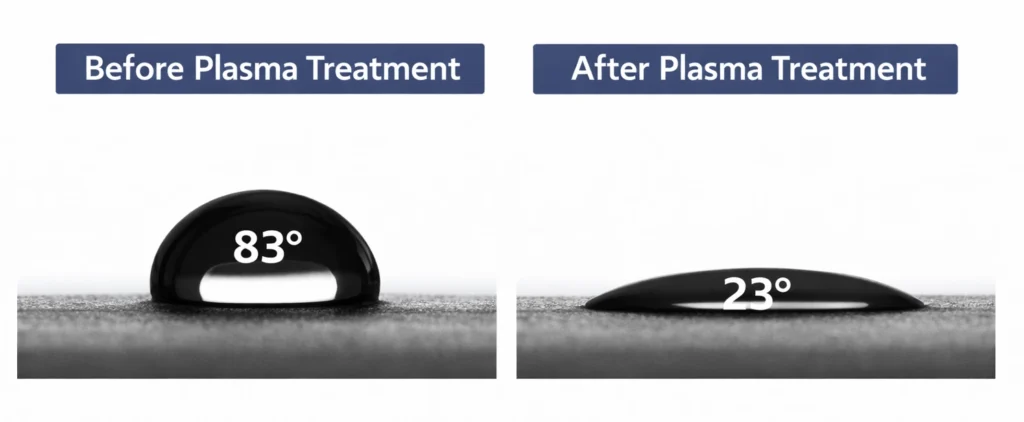
Contact angle measurements provide a clear visual indication of how plasma treatment affects surface energy. As shown in Figure 2, a surface analyzer measurement demonstrates how the contact angle of a droplet of liquid changed from a hydrophobic surface energy angle of 83° to a hydrophilic angle of 23° after treatment. This reduction indicates that the material surface has been cleaned effectively and activated, making it more receptive to inks, coatings and adhesives.
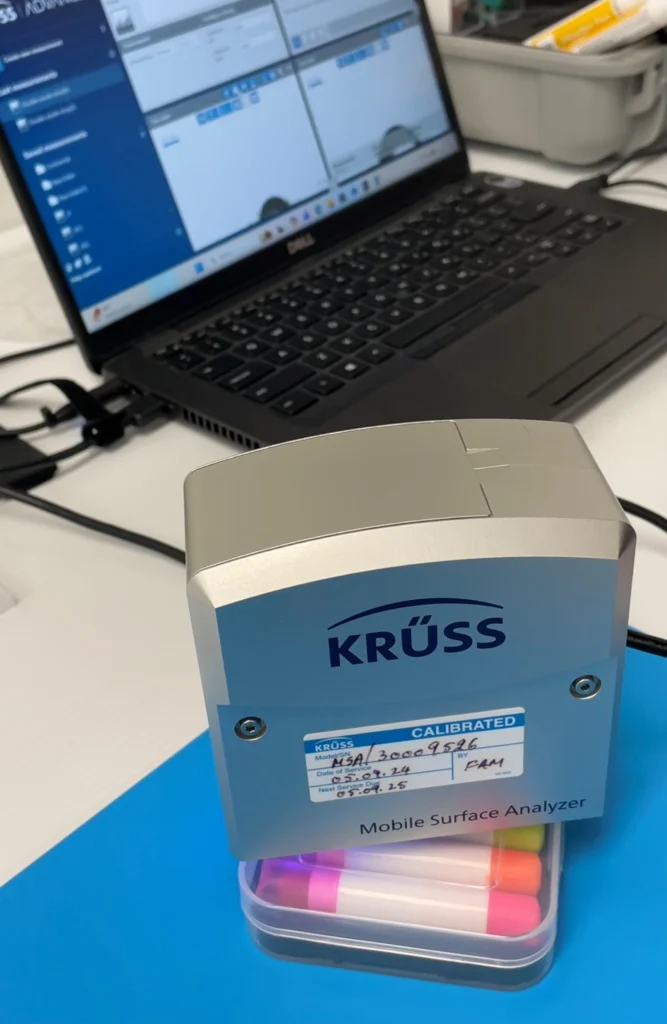
Contaminants, such as release agents and dust, can act as a barrier on the surface, increasing the contact angle and preventing proper wetting. As shown in Figure 3, surface analyzers provide a fast, quantitative method for evaluating surface energy by measuring how well water spreads – or “wets out” – on the substrate. Many plastics processors opt for using dyne pens and dyne inks as a quick and inexpensive way to estimate surface energy.
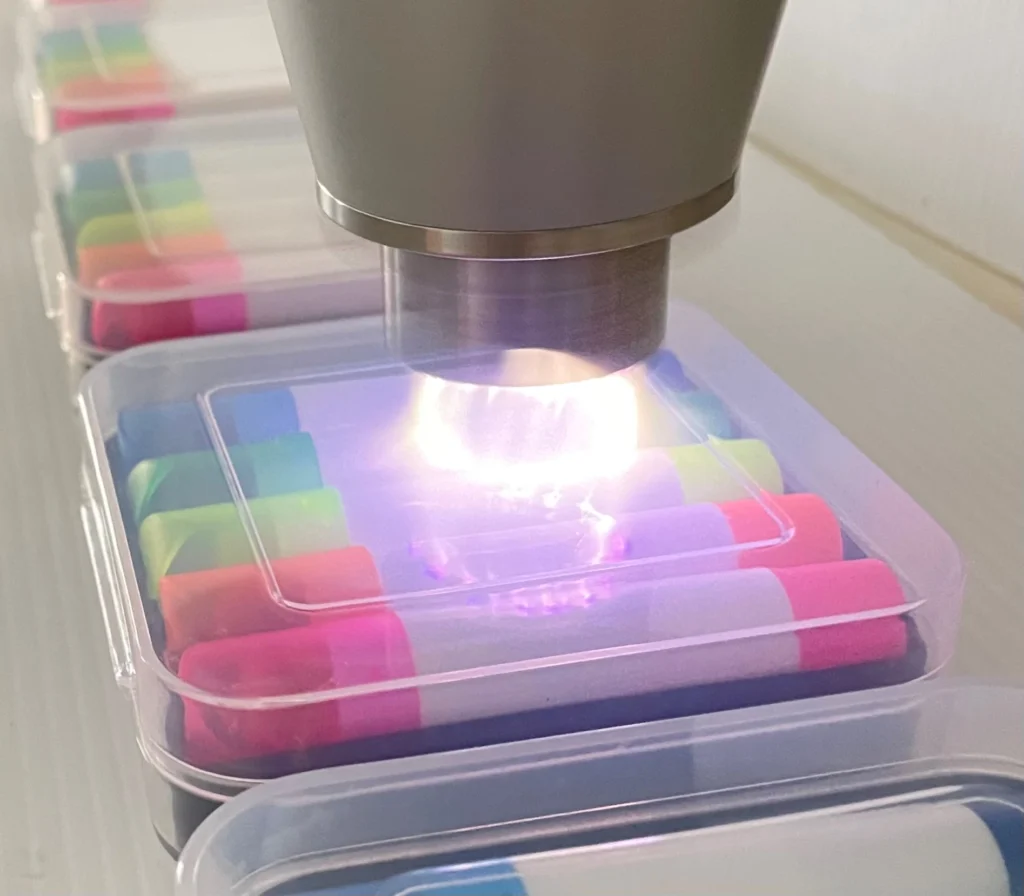
Due to the fact that atmospheric plasma performs cleaning and surface activation in a single step without chemicals or abrasives, it provides a fast, repeatable way to prepare plastic parts for decoration in high-speed production environments while reducing waste (see Figure 4).
Advantages of Plasma Cleaning
Traditional cleaning methods, such as grit blasting, solvent washing and batch plasma chambers, can prepare plastic surfaces for decoration, but each has limitations in a production environment. Grit blasting can be labor-intensive and difficult to integrate into an inline process. At the same time, solvent or chemical washing introduces potential health risks for operators and environmental concerns related to chemical handling and disposal.
Batch plasma chamber systems provide effective surface treatment, but it is a slower method because parts must be loaded and processed in batches rather than continuously on a production line.
Atmospheric plasma treatment is potential-free and therefore capable of treating conductive and nonconductive materials. Applications involving metal containers, treating near metal parts, embedded electronics, circuit boards, etc., are possible; whereas, corona treatment is not compatible with metal parts.

Atmospheric plasma is a more energy-efficient alternative. Because the process operates at atmospheric pressure, it can be integrated directly into automated production lines for inline treatment, allowing parts to be cleaned and activated in a single pass while maintaining high throughput (see Figure 5).
Plasma systems allow treatment levels to be adjusted and monitored accurately, producing consistent surface preparation from part to part. In contrast, flame systems can be more difficult to control and often require higher energy consumption. Therefore, atmospheric plasma provides manufacturers with a safer, more controllable and production-friendly approach to preparing plastic parts for decoration and coating processes.
Plasma Treatment/Cleaning Environmental Benefits
Atmospheric plasma surface treatment offers several environmental advantages compared to traditional surface preparation methods. Since plasma is a dry, non-chemical process, it eliminates the need for primers, solvents and other chemical adhesion promoters that can produce hazardous waste and VOC emissions.
By activating the surface without chemicals, plasma treatment allows manufacturers to transition more easily to environmentally friendly technologies, such as water-borne or UV-curable inks and coatings. These newer ink systems often require higher surface energy to achieve reliable adhesion, which plasma treatment provides.
Plasma treatment also supports a cleaner production environment. The process produces no ozone and does not generate the exhaust associated with flame treatment or solvent-based cleaning methods. Because it is a non-contact, electrical process, it also eliminates many of the safety and health concerns associated with open flames or chemical surface preparation.
From an energy and resource standpoint, plasma systems also can be highly efficient. They operate only when needed, utilize less energy than flame treatment, require no consumable chemicals and reduce material waste by improving adhesion and minimizing rejected parts.
Case example
One manufacturer producing small plastic parts tracked scrap rates on a painting line before and after integrating atmospheric plasma treatment for inline surface preparation. After installing the plasma system, scrap was reduced by 42%, and the process now consistently operates with scrap rates as low as about 2%.
In short, plasma treatment helps manufacturers improve product performance while reducing chemicals, emissions and waste – supporting green manufacturing.
Considering Other Surface Treatment/Cleaning Methods
Atmospheric plasma is used widely for inline surface preparation in plastic decorating applications, but other treatment technologies may be better suited depending on the material, contamination level and production process.
Vacuum or chamber plasma systems can be beneficial when uniform treatment is required across all surfaces of a part, including internal features or recessed areas.
Corona treatment commonly is used to increase surface energy on three-dimensional parts, sheets, panels and continuous web materials, such as films and foils. However, corona’s ability to remove surface contamination generally is limited compared to plasma-based cleaning methods.
Flame treatment sometimes is used for large molded polyolefin parts in high-volume production environments where the primary goal is to increase surface energy. However, flame systems require careful control and relatively high energy input to maintain consistent treatment conditions.
Plastic processors also may use solvent cleaning or aqueous washing systems as a relatively inexpensive method for cleaning smaller parts. In some cases, heavily contaminated components require these more aggressive cleaning methods before plasma treatment is applied for final cleaning and surface activation.
Atmospheric plasma typically is preferred when manufacturers need precise, repeatable surface treatment and cleaning that can be integrated directly into automated production lines.
Conclusion
Manufacturers selecting a plasma treatment and cleaning system should work with an experienced supplier that evaluates the application, tests materials and designs a system tailored to their specific material and production process to ensure consistent surface preparation and reliable adhesion.
Erik Kiel is the founder and president of 3DT LLC. With more than 35 years of experience in surface treatment technology, 3DT LLC manufactures atmospheric plasma and corona systems engineered for precision, consistency and long-term performance. 3DT’s standard and custom equipment improve surface energy to achieve exceptional adhesion and cleaning across a wide range of materials, geometries and applications. For more information, visit www.3DTLLC.com.