

By Dianna Brodine, vice president, editorial, Plastics Decorating
As fire safety systems become increasingly intelligent, the reliability, readability and functionality of the control panel at the heart of the system is more critical than ever.
InMold Solutions, based in Phoenix, Arizona, stepped in to produce a part for brand owner Honeywell that not only maintained the alarm systems’ high reliability requirements in the field, but also added functionality, durability and visual appeal.
Meeting the Highest Standards
InMold Solutions (IMS) is a technology-driven company specializing in in-mold decorating, in-mold electronics and custom injection molding solutions. According to the company’s website, IMS combines engineering expertise with vertically integrated production capabilities to help customers streamline manufacturing, enhance product aesthetics and functionality, and accelerate time to market. InMold Solutions utilizes turnkey production cells, system integration services and production support to incorporate advanced decorating and electronic integration technologies directly into molded plastic components.
The Honeywell Notifier alarm panel finds use in commercial, industrial, healthcare and educational facilities. Behind every panel is a sophisticated production process that combines precision electronics manufacturing, rigorous quality control and compliance with stringent industry standards.
Jeff Davison is the general manager of InMold Solutions, and IMS partnered with East West Manufacturing (label printer) and Sabic (film supplier) to produce approximately 10,000 units. “The printed sheets were provided to us by East West, and we returned molded, decorated parts to them, which then were shipped to one of their facilities in Mexico for additional value-added operations before being delivered to Honeywell,” explained Davison.
Complex Production Steps
A key element of the panel’s appearance and durability is the use of in-mold decorating (IMD), a manufacturing process that integrates graphics, labeling and functional surface features directly into molded plastic components. By embedding logos and interface markings into the panel during molding, IMD creates a highly durable surface that resists scratching, fading and chemical exposure while maintaining a professional appearance throughout the product’s service life. IMD also offers design flexibility.
“This alarm panel part is offered in multiple configurations to support numerous applications,” said Davison. “Simply changing the printed film offers valuable flexibility from a single injection mold.”
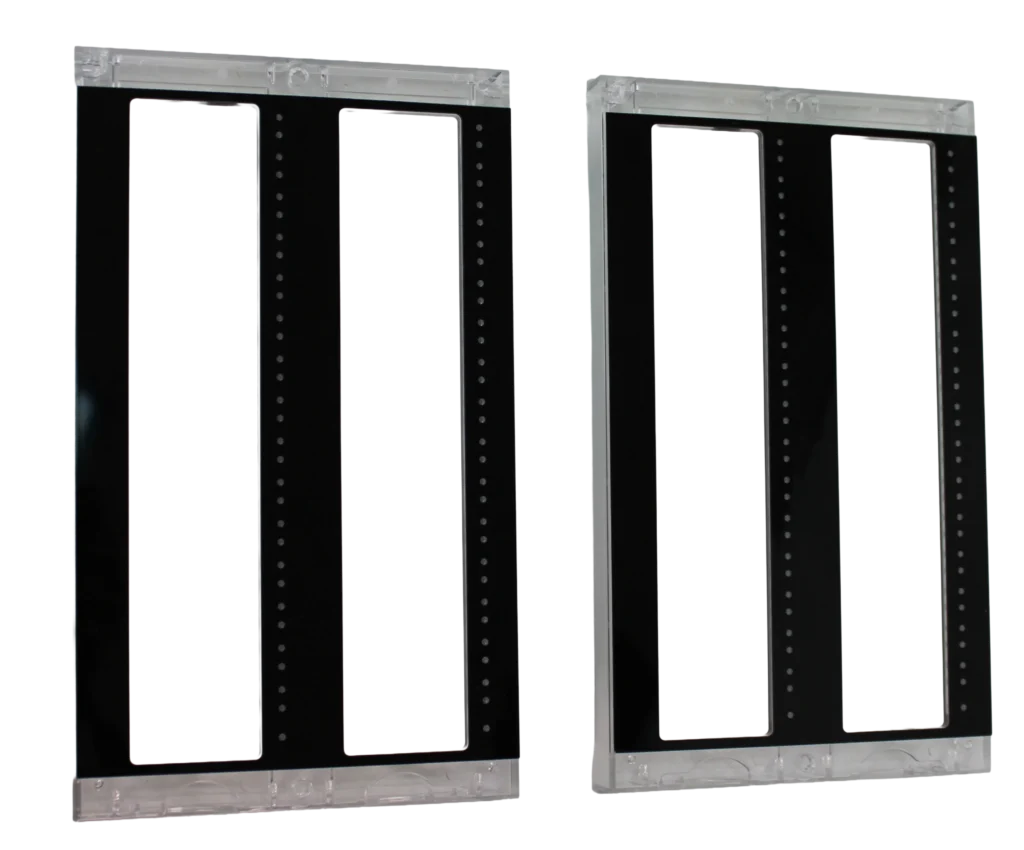
Adding to the complexity, there are 62 molded-in LED light pipes each with a diameter of 0.077” spread over two rows spanning more than 7” in length each. “The printed film has 62 dead-front printed circles that need to align tightly with each individual molded light pipe,” said Davison. “As the resin enters multiple gates at one end of the part, it must flow fast enough to travel over 8” to fill the part completely but also slow enough not to wrinkle the film or wash the ink away.”
Pre-production diligence was the key to success with this product. “We provide a preliminary Design for Manufacturability (DFM) review during the quoting stage, and once a job is awarded, we do a conceptual mold split showing intended parting line split, cavities and cores, gating and ejection,” explained Davison. “The team reviewing this includes the printer, form and trim shop, the molder, the tool maker and the simulation house. If there are no major objections from the team, we proceed with a Stage I Mold Flow analysis to evaluate cavity fill time, pressure, balance, shear rates, etc.”
The results of this simulation are reviewed for any design concessions to the part or the mold design. Then, the mold design moves to preliminary status by incorporating adjustments to the part and/or tool design and adding water lines to the mold. Next, mold flow analysis is used to evaluate cooling and warp predictions.
In the case of the Notifier alarm panel, the optimal flow rate was established, but it resulted in the film stretching and misaligning the registered printed light pipes. Once the stretch rate was plotted, the printing layout was modified to match and resulted in a small process window to achieve all requirements. Additionally, the film is flat with no formed geometry to align in the injection mold, so precise placement of each appliqué was critical. A static pinner was used to hold the appliqué in the correct location after placement.
Reliability Enabled by IMD
The use of in-mold decorating in the production process also supports manufacturing efficiency by eliminating secondary printing and labeling operations, reducing assembly time and improving consistency. That consistency is even more important in critical safety products such as control panel components and user interfaces. The use of in-mold decorating helps ensure that Honeywell Notifier alarm panels deliver both reliable functionality and long-term visual performance in demanding commercial environments.
“This panel is actively in production as a commercial business-to-business product,” explained Davison. “Working with our partners and modeling the manufacturing process from beginning to end ensured success for both our team and Honeywell.”