

By Jason Dornbos, director of sales, Extol, Inc.
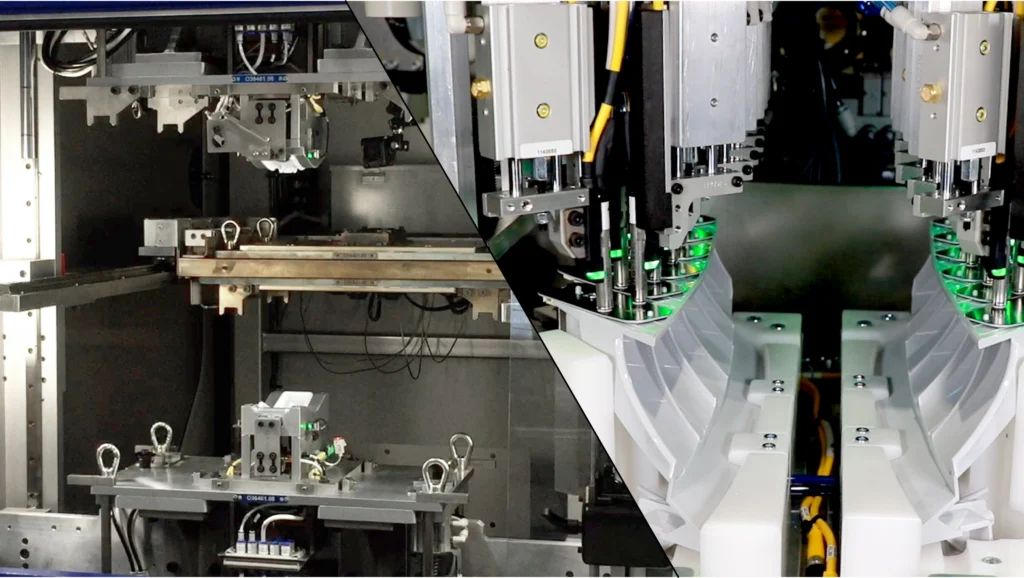
When designing a plastic assembly, one of the earliest and most important decisions engineers face is how the parts will be joined. Two of the most common options are plastic welding and plastic staking. While both methods are widely used, they serve very different purposes and lead to different outcomes in terms of strength, appearance, cost and performance. When evaluating plastic joining methods early in the design process, understanding the difference between plastic welding and plastic staking can help avoid costly redesigns and manufacturing challenges later in the manufacturing process.
What Is Plastic Welding?
Plastic welding is the process of heating two thermoplastic parts and pressing them together to form a molecular bond. As the plastic melts, the polymer chains flow together. Once cooled, the joint behaves as if it were a single molded component.
There are several plastic welding technologies, each with distinct advantages depending on part size, material and performance requirements. The methods listed below are among the most common approaches across a wide range of applications:
- Hotplate welding – A robust process that uses conduction to apply heat to the joint that commonly is used for larger components, such as automotive housings, batteries, glove boxes and coolant bottles.
- Ultrasonic welding – A fast process that uses high-frequency vibration to create heat through friction, often used for small, rigid parts.
- Laser welding – A precise method well-suited for clean, highly controlled joints, such as medical components, microfluidics and electronic housings.
- Infrared (IR) welding – Uses focused infrared energy to melt the joint interface without contact, reducing particulate and cosmetic damage.
- Spin welding – A friction-based welding process that involves rotating one plastic part against another under pressure to generate heat and form a weld, which only is suitable for parts with a round weld joint.
- Vibration welding – A process that generates heat by vibrating one plastic part against another under pressure, commonly used for large parts.
Key Characteristics of Plastic Welding:
- Produces a molecular (fusion) bond
- Can create hermetic, air or watertight seals
- Typically offers high structural strength
- Requires material compatibility between welded parts
What Is Plastic Staking?
Plastic staking is a mechanical fastening process, not a molecular joining method. A molded plastic boss or stud is inserted through a mating component, then heated and reformed into a “stake head” that mechanically retains the part – similar to a plastic rivet.
Only one component needs to be plastic. The mating part can be metal, another plastic, a PCB or another material, as long as it has a hole or feature to accept the boss.
Common plastic staking technologies include the following:
- Infrared (IR) staking – IR uses focused infrared energy to heat the boss without contacting it.
- Smart heat staking – A smart punch rapidly heats and cools to form the boss via conduction.
- Ultrasonic staking – Ultrasonic staking uses vibration to generate frictional heat.
- Hot punch staking – A basic heated punch transfers heat directly into the boss.
After forming, the plastic cools and solidifies, creating a strong and repeatable mechanical joint.
Key Characteristics of Plastic Staking
- Creates a mechanical joint, not a fused bond
- Can join dissimilar materials
- Eliminates screws, clips and adhesives
- Excellent for cosmetic and electronics – sensitive assemblies

The Fundamental Difference: Molecular Bond vs. Mechanical Joint
The most important distinction between plastic welding and plastic staking is how the joint is created (Figure 1). Plastic welding produces a molecular bond, fusing compatible plastic materials together into a single structure. Plastic staking produces a mechanical joint, where a reshaped plastic boss physically retains another component. Because of this difference, staking often uses multiple bosses to achieve the required overall assembly strength, while welding relies on the strength of the continuous joint itself.
When Plastic Welding Is the Better Choice
Plastic welding typically is the right solution when:
- High structural strength is required
- The joint must be airtight or watertight
- The assembly needs to function as one unified part
- Both components are compatible thermoplastics
- Longterm durability under load or pressure is critical
Applications such as fluid containers, enclosures and structural housings often rely on welding for performance and reliability.
When Plastic Staking Is the Better Choice
Plastic staking often is the preferred option when:
- Dissimilar materials must be joined (plastic to metal, PCB, or glass)
- Fasteners need to be eliminated to reduce costs or assembly time
- Cosmetic surfaces must remain clean and unmarked
- Service loads are moderate, and sealing is not required
Common examples include automotive interior trim, electronic PCBs, control panels and medical devices.
Design Considerations That Influence the Right Choice
Choosing between welding and staking isn’t just a manufacturing decision – it’s a design decision. Key factors that should be evaluated early include the following:
- Part geometry and access to joints or bosses
- Material selection and thermal sensitivity
- Required joint strength and durability
- Cosmetic surface expectations
- Automation and cycle time goals
Designing a part for staking is very different from designing a part for welding. Optimizing for one process rarely translates well to the other.
A frequent mistake engineers make is committing to a part design before fully evaluating the joining method. Late stage changes often occur because the selected process:
- Damages sensitive components
- Leaves visible cosmetic defects
- Fails to meet strength or quality requirements
- Adds unexpected cycle time or cost
Evaluating plastic welding and staking early in the design phase helps reduce risk, rework and time to market.
Conclusion
Understanding the strengths and limitations of both plastic welding and staking will allow engineers to make more confident design decisions and build assemblies that perform as intended in production. To ensure the right joining process for each assembly application, evaluating materials, geometry, performance requirements and appearance expectations together is the fastest path to the best outcome. n
Extol, Inc. designs and manufactures plastic welding equipment and custom assembly systems for all types of manufacturing applications. For more information, visit
www.extolinc.com.