

By Paul Uglum, president, Uglum Consulting, LLC
There is an increased interest in bringing back domestic manufacturing to create jobs and better enable America to compete globally. The reasons behind the reshoring of manufacturing in general – and plastic decorating manufacturing specifically – are many and diverse. The questions are how best to understand the trend and when to take advantage of the opportunities that arise from it.
Over the past decades, manufacturing has moved from domestic locations to overseas low-cost manufacturing sites, primarily in China, or to closer, lower-cost sites, like Mexico (Figure 1). Both business decisions and political decisions to open previously closed regions helped drive this trend. Initially, the focus was on the low cost of labor in these locations, but over time these countries developed a skilled workforce, supply infrastructure and experience rapidly introducing new product variations. This particularly was true for China, but surrounding countries gradually have followed this model and increased foreign competition.
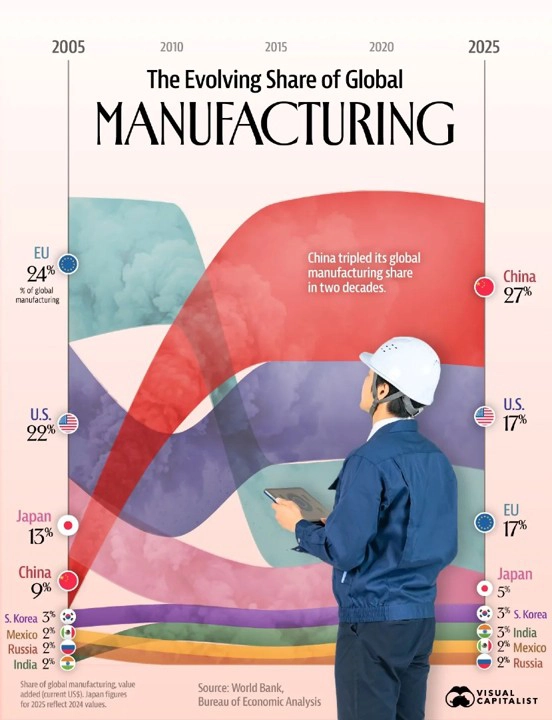
The 2026 Reshoring Survey shows that US manufactures are growing the pipeline for domestic suppliers, with an increase in activity both by original equipment manufacturers (OEMs) and contract manufacturers (CMs). Opportunities exist, but it is important to look at both the conditions driving the trend as well as the issues that enable – and also limit – opportunities. Causes ranging from the pandemic-induced supply chain failure to tariffs, geopolitical risk, intellectual property theft and environmental social governance (ESG) accountability have worked together to create an environment that encourages the reintroduction of and increased opportunity for domestic plastic decorating manufacturing.
Manufacturing job openings jumped in July, increasing the vacancy rate to 4.4% up from 3.3% last year. This primarily was in the sector of durable goods. While these may not be reflected immediately in the plastic decorating portion of manufacturing, it is an indication that things are moving in the right direction.
Opportunities
Where and when do the opportunities arise for plastic decorating? First, it is important to understand where plastic decorating exists in the broader scheme of things. At a basic level, all manufacturing exists to make a useful or desirable product. It is useful to group these similar useful products together into market segments, such as automotive, medical hardware and packaging (although the packaged product is the actual useful product). Similar to plastic manufacturing, plastic decorating is critical to a wide range of business segments and occurs upstream of the final finished product. Although the techniques are common across businesses where plastic decorating exists, the value stream ranges widely from process-specific contract manufactures to vertically integrated OEM manufactures of complex products.
Each market is structured differently. Packaging requires a smaller upstream ecosystem than consumer electronics. Automotive and Aerospace require extensive testing and long verification times. Medical is highly regulated with strict validation requirements. Because of this, opportunities for new business growth are not distributed evenly and do not occur at the same rate. The pace is limited by price competition, policy uncertainty and a shortage of skilled workers. Beauty and personal care packaging is projected to grow around 7.8%, while the automotive sector is expected to be in the range of 3.5%. Growth also is concentrated in higher-value products that carry greater demands for appearance and performance.
Domestic growth in plastic decorating manufacturing occurs because a business segment is growing, styles and expectations are changing (requiring differing techniques to meet customers’ goals) or businesses are, for various reasons, seeing suppliers that are closer to their manufacturing locations.
Opportunities exist, as some decorative manufacturing is moving out of China. Although a portion is moving to the US and Canada, a greater share is relocating to other low-cost Asian countries, such as Vietnam. Additionally, Germany’s deindustrialization is creating opportunities for some industries as the cost of energy and level of regulation increase in Europe.
Articles in the recent Beauty Packaging issue describe the drivers specific to the cosmetics packaging market. Reliable supply chains and speed to market are primary priorities for this business segment. Not specifically mentioned, but equally important, is the total actual cost per part rather than just the quoted price per part. The packaging market does not have as complex an upstream ecosystem as many other segments and is able to take advantage of the trend more quickly.
Reshoring Drivers
It is useful to examine some of the drivers of reshoring, not only because their impact varies by business segment, but also to understand how they can affect current manufacturing supply chains.
Supply Chain Disruption and Geopolitical Risks
Covid 19 reminded manufacturers just how fragile a global supply chain can be. Although the pandemic has passed, the current supply chain risks have not. Geopolitical conflict, both military and diplomatic, has made delivery chains unreliable. Trade disputes, export controls and energy costs all have added to the uncertainty and volatility of prices. Trade disputes are particularly problematic since they cannot be predicted with any certainty. Domestic production escapes some, but not all, of the issues. It is critical to understand how the incoming supply chain can impact domestic production and seek stable sources of needed raw materials.
Rising Offshore Costs
China’s significant production cost advantage is eroding as wages rise. That leaves the choice of moving country to country in search of the next low-cost option or investing in more stable domestic production. It is important to consider the total cost of the purchased part (or manufactured part) rather than the piece price. Unfortunately, in too many cases, procurement departments tend to focus only on the as-delivered piece price rather than on the long-term stability and reliability.
Intellectual Property Risks
For years, it has been documented that, after providing their proprietary design and manufacturing technology, companies find that suppliers have used this information to become competitors. This erodes the very intellectual property (IP) meant to give a competitive advantage.
There are other more subtle and often neglected issues related to IP. Without internal manufacturing capability, companies lose the communication that provides feedback for improving designs. Not only is there a loss of the knowledge base for manufacturing processes, but there also is a significant loss in the capability to use that manufacturing knowledge to create new IP on both the design and manufacturing sides.
Liabilities from Offshore Manufacturing
There are a number of risk drivers from offshore manufacturing. Some stem from tightening regulations, such as extended producer responsibility (EPR). Reputational risk also can arise from lax oversight and from variable part quality. Poor environmental practices, labor conditions and human rights issues are becoming more visible and of greater concern to customers.
Plastic Decorating Environment
The manufacturing environment consists of a number of nested ecosystems that depend upon each other for success (Figure 2). Depending upon the complexity of the end product and the degree of vertical integration, there can be many layers of suppliers, from raw materials through plastic manufacturing and decorating, feeding successive supplier tiers and ultimately the OEM customer.
Within plastic decorating, each significant process has its own ecosystem. These frequently are co-located with plastic molding, and often there will be several distinct and unique technologies at the same location.
As discussed in previous articles, plastic decorating processes tend to be sophisticated and multifaceted. Moreover, each decorating process is supported by an entire ecosystem of critical operations and activities. These include raw materials handling and part preparation, both of which feed into the process. They also include the surrounding environment, quality control and assessment. Beyond the supply chain, a skilled, knowledgeable staff is core to this.

With Opportunity Come Risks
Given the complexity of the manufacturing environment, many of the same global trends creating opportunities for reshoring also have the risk of causing plant-level disruptions for domestic manufacturing. Recent conflicts and tariffs have caused plastic and raw material costs to fluctuate wildly, eroding margins and making quoting difficult.
Higher expectations for quality, reliability and speed to market make managing core business execution a focus and critical to both preserving current business and seeking new opportunities.
If companies seek to grow by expanding into new markets, they need to understand the intended target market. Key to this is knowing the trends, expectations and behavior of the final product producers. At a minimum, companies must understand their procurement, design and engineering functions. It also is important to understand which department is dominant in decision making. Evaluate quotes. Some only are used to determine market pricing, but all contain the opportunity to better understand what the customer expects.
A final concern is a knowledgeable design and manufacturing staff that understands the manufacturing processes, their limits and possibilities. With offshoring, downsizing and older employees aging out, significant tribal knowledge gets lost and is not easily recovered (Figure 3).

In some technologies, such as coating processes, a substantial amount of literature and training resources still are available. In other cases, companies have relied more heavily on trade secrets and tribal knowledge, which must be relearned. Some universities, such as Ferris State, offer classes in plastic decorating, but these are the exception. Make sure the engineers and operators have opportunities for proper training and can develop contacts in their respective fields. The good news is fundamental innovation still is occurring both domestically and in other high-cost manufacturing countries.
Artificial Intelligence (AI) can help with some activities if adequate quality data is available. AI successfully has been used in applications such as formulation design, quoting and managing operations. The issue is the quality and availability of the data; uncaptured tribal knowledge or corrupted data are useless or can lead to significant errors.
To reduce risk, companies should manage their existing business and control the in-house costs. They should focus on their strengths and align them with meeting customers’ needs. Diversifying their customer base can reduce the impact of market segment fluctuations. Automation can help, but companies should ensure that volumes and applications can support the investment.
Final Notes
Both the rate and the extent of growth in plastic decorating manufacturing will vary depending upon the market segment. In some cases, domestic customers, although fewer in number, never entirely disappeared. In other cases, such as with fabrics, entire industries exited the market. As a result, their supply base and the experience contained within it disappeared. It is much easier to destroy a market than to rebuild it.
Companies need to take time to understand their target markets. This should include both the end customer expectations (and, more importantly, end user purchasing behaviors) and the customer to which they are supplying the decorated parts. Develop relationships that foster dialogue rather than just waiting for quotes. Following trade journals, attending trade-related conferences and being aware of current trends all are important parts of the puzzle.
Reshoring is occurring. The pace is limited by price competition, policy uncertainty and a shortage of skilled workers. Jobs and an expanded economy are some of the tangible benefits of reindustrializing America, but there is something more fundamental going on as well. It has been said that great countries make things. Strong and stable superpowers can produce for themselves the goods crucial to national security, such as steel, chips and medicines. Expect the initial focus to be on those industries that provide economic security.
References
https://www.visualcapitalist.com/charted-the-worlds-top-manufacturers-2025-2025/
https://www.visualcapitalist.com/mapped-americas-top-employment-sector-by-state-1990-2025/
Paul Uglum has 43 years of experience in aspects of plastic materials, plastic decoration, joining and failure analysis. For more information, email paul.a.uglum@gmail.com.